Share Observation on Webinar GTI
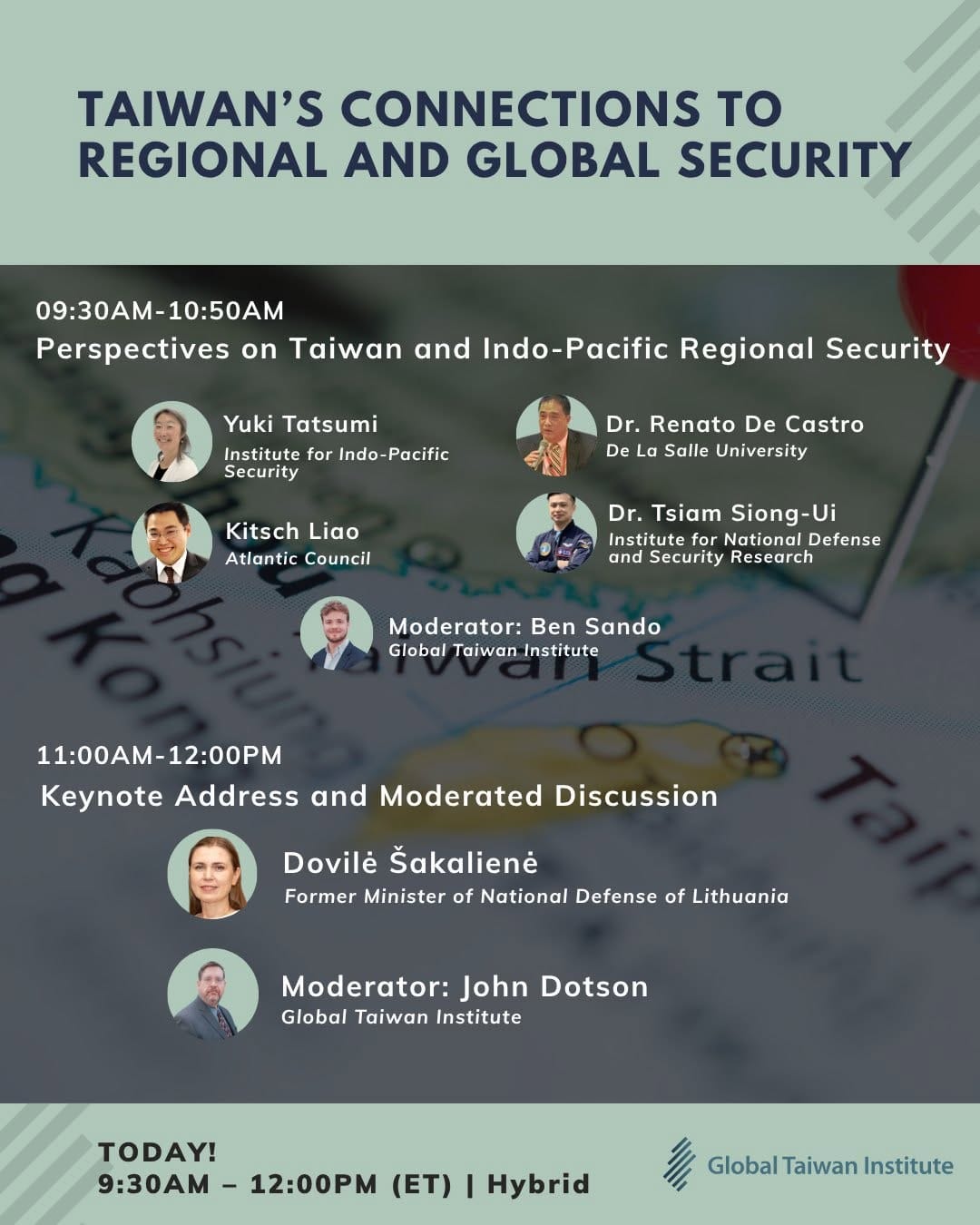
The Chief of Analise, Dr Siông-Ui, Frederick, TSIAM, was invited to provide insight into the latest T-Dome at the Global Taiwan Institute's webinar weeks ago.
Key points summarised below:
(you could also watch it on https://www.youtube.com/watch?v=uR4TanZNVJU)
Constructing a New Air Defence Architecture: The Strategic Role of Taiwan's 'T-Dome' in Indo-Pacific Coalition IAMD
Taiwan's defensive posture is currently undergoing a critical structural transformation. The recently debated 'T-Dome' concept should not be viewed merely as a new label for Taiwan's air defence system. Rather, it must be understood as an emerging effort to align Taiwan's defensive architecture with the broader logic of Integrated Air and Missile Defence (IAMD). In this sense, T-Dome is not detached from Coalition IAMD; it is its frontline manifestation on the First Island Chain.
The Nature of the Threat: Volume, Tempo, and Cognitive Warfare
When assessing Taiwan's air defence, one cannot solely focus on a handful of high-tech threats. The People's Liberation Army (PLA) possesses a full spectrum of short-, medium-, and intermediate-range missiles, supported by drones, aerial platforms, and multiple launch rocket systems (MLRS). From a defensive perspective, we must seriously address the prospect of high-volume, saturation attacks.
Operating at ranges of roughly 130 to over 500 kilometres, long-range MLRS do not require pinpoint accuracy to inflict significant physical damage. More crucially, these attacks play a vital role in cognitive and hybrid warfare. Their objective is not simply to destroy infrastructure, but to induce public panic through sustained, high-intensity strikes, fostering a sense of futility and the belief that democratic governance cannot protect them against an overwhelming force.
Initial estimates suggest that in the opening phase of a conflict, China could launch upwards of 1,700 rockets, accompanied by multi-axis drone and missile strikes. The core challenge, therefore, is not managing a small number of exquisite threats, but rather withstanding an overwhelming volume and tempo. Without proper integration, Taiwan risks exhausting its high-cost air defence interceptors on low-cost rockets and drones early in a conflict, leaving it vulnerable to precision missile strikes in subsequent phases.
From 'Layered Deterrence' to System Integration: The Four-Tiered Architecture of T-Dome
Against this backdrop, the T-Dome concept introduced by President Lai in October 2025 seeks to draw upon the operational experiences of Israel, Ukraine, and the United States to construct a more integrated, multi-tiered, and open-architecture missile defence network.
This is not simply old wine in a new bottle. Since the 2000s, Taiwan has maintained a strategic logic of 'layered deterrence' (重層嚇阻), striving to push engagements away from populated areas towards the maritime approaches. T-Dome preserves this logic but fundamentally modernises it for contemporary threats through digitisation and system integration, placing a paramount emphasis on battle management. This marks a paradigm shift from isolated legacy systems to an interconnected grid.
In practical terms, T-Dome is envisioned as a four-layered defensive architecture:
- High-Tier Defence: Primarily utilising the Sky Bow IV system to intercept ballistic missile threats, such as the DF-15 and DF-16, at altitudes of up to 70 kilometres and ranges exceeding 200 kilometres.
- Medium-to-High-Tier Defence: Integrating PAC-2/3, Sky Bow II/III, and NASAMS (currently being acquired) to counter land-attack cruise missiles (like the CJ-10) and medium-altitude long-endurance (MALE) UAVs (e.g., Wing Loong, CH-4, TB-001).
- Medium-to-Low-Tier Defence: Employing land-based Sky Bow II and associated systems to intercept lower-altitude and rotary-wing threats.
- Close-In Defence (The Last Line): Deploying Stinger missiles, C-RAM, and other point-defence systems to clear residual threats that penetrate the outer layers.
The critical takeaway is that these four tiers are meant to operate not as siloed batteries, but as a 'system-of-systems' tightly woven together by data links and a Common Operational Picture (COP). Past military procurement has often focused on tangible platforms, yet the true value of T-Dome lies in its intangible battle-management and network architecture.
Aligning with International Partners: Regional Joint Defence and Three Critical Gaps
Participating recently in an IAMD table-top exercise (TTX) hosted by the United States Studies Centre at the University of Sydney in Tokyo, I was struck by how closely the trajectory of T-Dome aligns with the broader Coalition IAMD initiative. Both concepts prioritise architecture over platforms, centre on battle management, and recognise that deterrence in the Indo-Pacific increasingly relies on the cross-domain—and eventually cross-border—integration of defensive systems.
However, conceptual alignment does not equate to operational integration. Drawing from the development of T-Dome and the TTX experience, Taiwan still faces three crucial gaps where deepened cooperation with allied partners is urgently required:
- AI-Enabled Battle Management and Decision Support: Facing high-intensity saturation attacks, Taiwan must accelerate its capacity to process vast amounts of data, prioritise threats, and rapidly allocate effectors. Better decision support under pressure does not merely save time; it saves lives.
- Resilient Data Links and Latent-Link Readiness: If Taiwan is to achieve coalition interoperability, secure and survivable communications are indispensable. While sharing fire control in peacetime is not required, the capability for wartime track-sharing is the foundational element for building a broader operational picture.
- Long-Range Sensing and Cost-Effective Magazine Depth: Long-range sensors buy critical reaction time, while sufficient magazine depth ensures survival. As an island, Taiwan faces immense challenges with wartime resupply; however, maintaining limitless stockpiles of expensive interceptors is unfeasible. A sustainable, smarter balance must be struck between interceptor volume and defensive cost-effectiveness.
Conclusion: Defending Taiwan is Defending the Indo-Pacific Strategic Balance
Taiwan's defence is by no means a purely local or regional issue. In the overarching strategic contest between democracy and authoritarianism, the annexation of Taiwan would not merely be a tragedy for the island itself; it would represent a profound political catastrophe for the democratic world, potentially triggering a post-Cold War domino effect that emboldens further totalitarian expansion.
Furthermore, even if the PLA fails to completely absorb Taiwan, successfully severing or disrupting the vital sea lines of communication (SLOCs) surrounding the island would fundamentally overturn the global strategic equilibrium. In such a scenario, the deterrence credibility of the democratic alliance would be severely degraded, unleashing economic and technological repercussions on a truly global scale.
Therefore, Taiwan does not sit on the periphery of a localised dispute; it stands at the absolute vanguard of a macro-strategic contest. Constructing a resilient 'T-Dome' architecture is not only about safeguarding Taiwan—it is an indispensable cornerstone for the future stability of the entire Indo-Pacific region.